

עיתונאיות ועיתונאים, הירשמו כאן להודעות לעיתונות שלנו
הירשמו לניוזלטר החודשי שלנו:
עיתונאיות ועיתונאים, הירשמו כאן להודעות לעיתונות שלנו
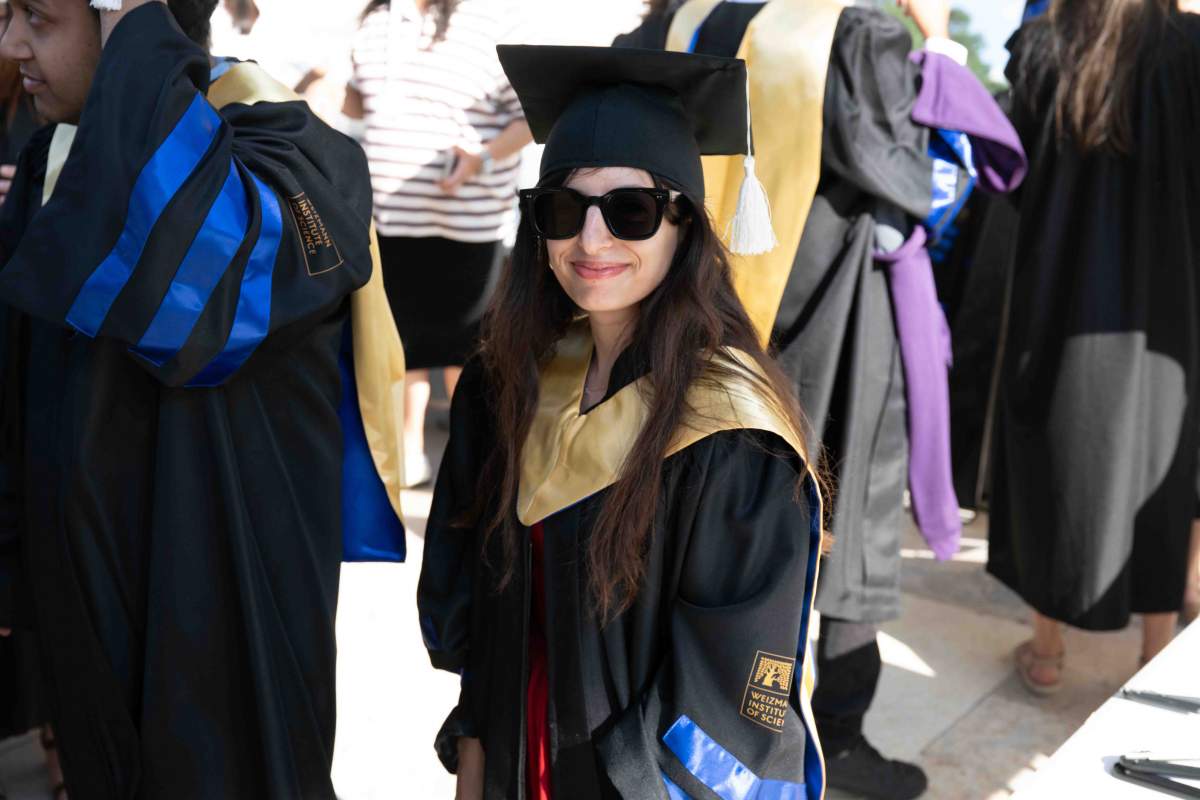
“I grew up in Nof HaGalil, in a home where no one had an academic education, but where there was always curiosity, creativity and a love of learning. My parents taught me to ask questions, observe the world and never be afraid to dream big. When I arrived here, I felt I had found a place where that curiosity could become a way of life.” With these inspiring words, Mazal Faraj opened her speech yesterday on behalf of the alumnae and alumni at the annual graduation ceremony of the Weizmann School of Science.
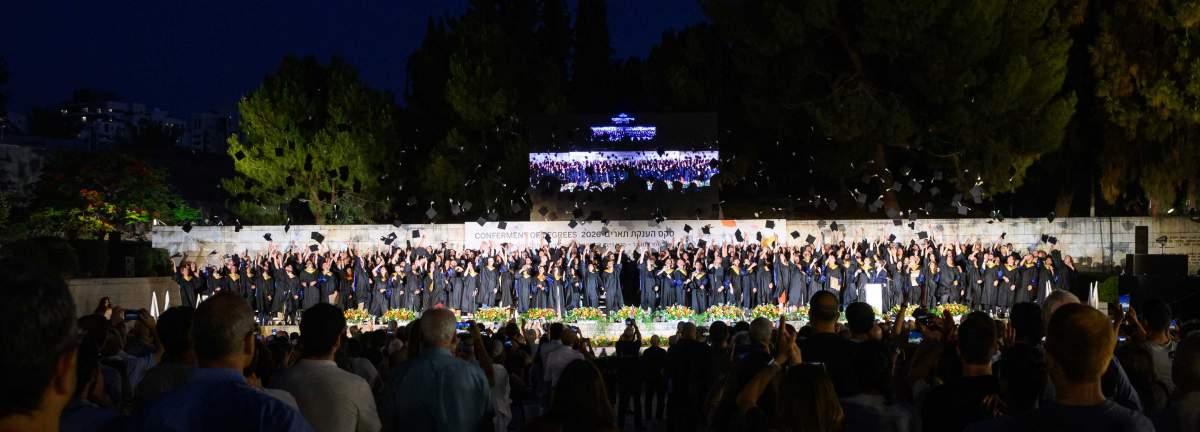
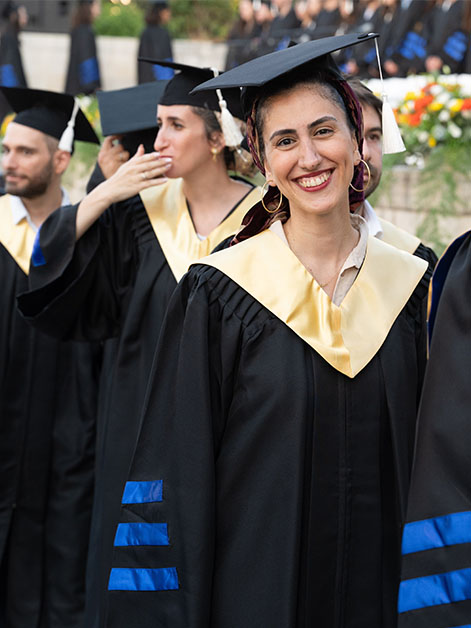
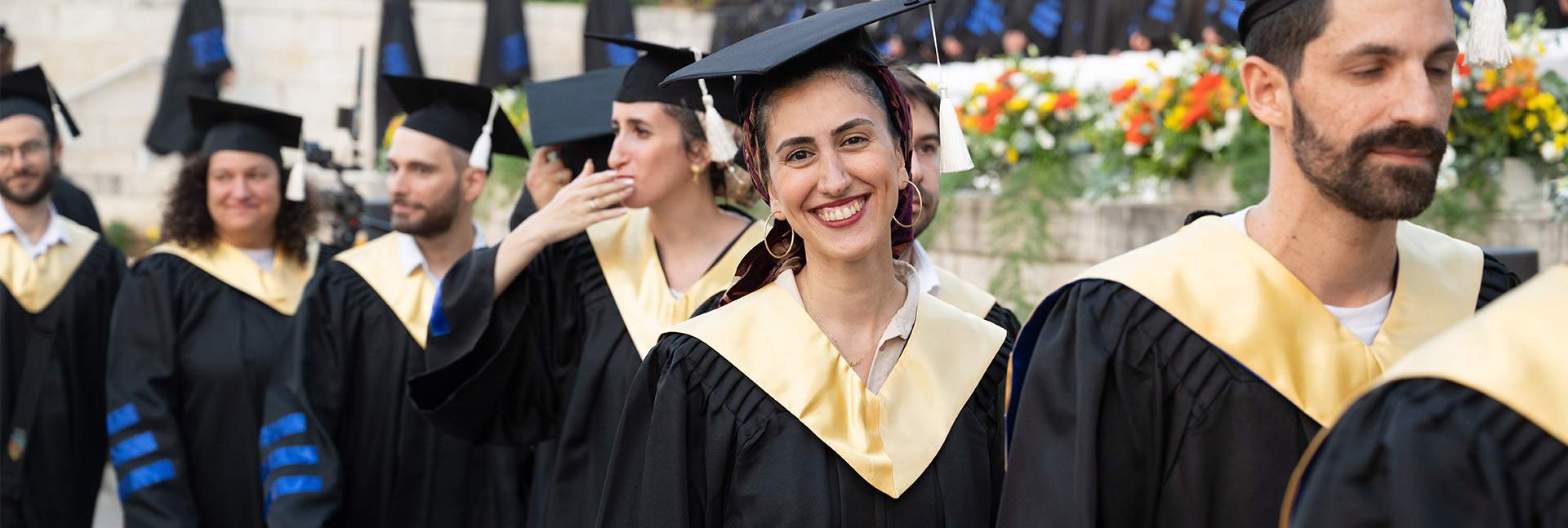
This year, 144 women and 207 men completed their studies at the Weizmann Institute of Science’s School of Science, including 124 new PhD graduates and 227 master’s degree recipients. Despite the state of war in Israel, which directly affected the Weizmann campus, 47 international research students were among those donning gowns and caps. They came to study in Israel from China, India, Germany, Russia, Ukraine, Belarus, Sweden, Czechia, Italy, France, Belgium, Serbia, Hungary, Switzerland, Finland, Colombia and the United States. International students accounted for more than 20 percent of this year’s doctoral graduates.
“Our journey toward a master’s degree did not take place in a sterile bubble. It began just a few months after October 7. We tried to balance rotations, courses and experiments with a reality of war and uncertainty. Some of us – myself included – served at the same time in the reserves and in emergency organizations, and volunteered in our communities. Through it all, the Weizmann Institute was an island of stability amid the storm. Our laboratories became anchors, sanctuaries and family. Even when the labs were damaged by a missile strike and shut down for a time, we worked tirelessly to restore them. We learned how to keep going – just as we do in science: to cope with the unexpected, recalculate our course and try again from the beginning,” Faraj said.
She joined the Institute in the summer of 2021 as part of the inaugural cohort of the Young Weizmann Scholars – Excellence and Diversity Program, which promotes opportunities for students from groups underrepresented in academia. Having completed her master’s degree yesterday, she is now pursuing a direct-track PhD in the Systems Immunology Department under the supervision of Prof. Rony Dahan.
""They call academia the ivory tower, detached from the worries of the world. During our tenure, however, the very foundations of the tower shook"
Also speaking on behalf of the graduates was Dr. Aaron Liberman, who completed his doctoral studies in the laboratory of Prof. Victor Malka in the Physics of Complex Systems Department. Raised in New York, Liberman discovered physics thanks to an inspiring teacher, went on to study physics and mathematics at Columbia University, and later immigrated to Israel and joined the Weizmann Institute.
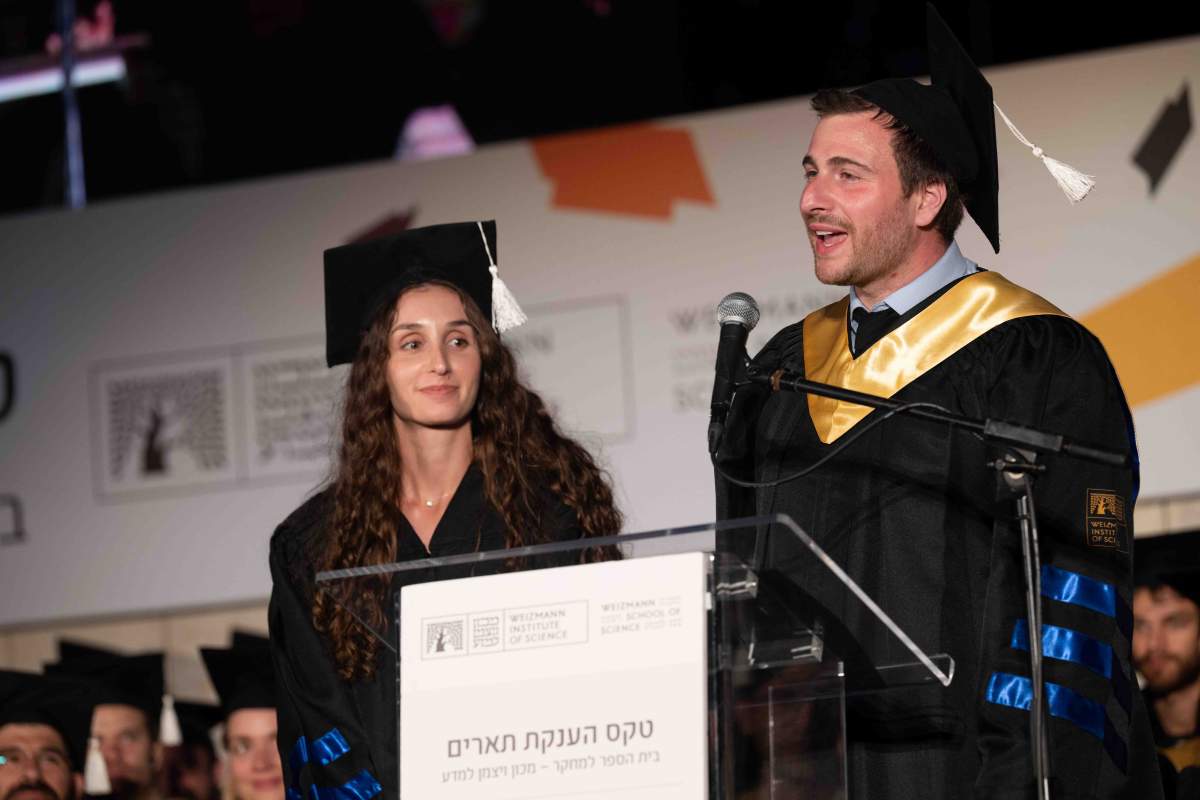
“How lucky are we, to have gotten the chance to play in Weizmann’s state-of-the-art facilities, to travel the world through conferences and collaborations, and to have access to gourmet cuisine at the San Martín lunch hall. Okay, maybe that last one was a bit of a stretch,” Liberman said in his address, drawing applause and laughter from the audience. He continued on a more serious note, however: “They call academia the ivory tower, detached from the worries of the world. During our tenure, however, the very foundations of the tower shook. Amid lockdowns and air raid sirens, even the gates of Weizmann couldn’t keep world events at bay… While I hope that future generations of students know only the joys of learning on Weizmann’s lush campus and not the worries of pandemics and wars, it has been an inspiration to see the Weizmann Institute rise to meet seemingly insurmountable challenges with grit and grace.
“Where else would scientists publish groundbreaking research in Nature Medicine days after their lab was burned down? Who else would win six ERC grants 48 hours after being targeted for destruction? Weizmann’s resilience and fierce determination to excel in the face of adversity is a lesson we take with us.”
The evening’s guest of honor was another Weizmann alumnus – Prof. Amnon Shashua, president and CEO of Mobileye. Before becoming a world-renowned scientist, entrepreneur and pioneer, Shashua began his journey on the Institute’s campus.
“This evening takes me 40 years back, to 1986. I arrived on this campus to pursue a master’s degree under the supervision of Prof. Shimon Ullman, and that encounter changed the course of my life. I had the privilege of studying and thinking alongside scientists who set an extraordinary intellectual standard: David Harel, Adi Shamir, Tamar Flash, Ehud Shapiro and Achi Brandt. Equally important, I formed friendships here with fellow students – friendships that remain with me to this day.
""A good algorithm is not merely an elegant line in a paper. It must confront sensors, noise, uncertainty, regulation, human responsibility and the scale of millions of users"
“That period shaped me as a researcher, but in hindsight I realize it also shaped my outlook as an entrepreneur. I watched Shimon Ullman move seamlessly between top-tier basic research and applied work at Orbotech. It was there that I first understood that the distance between a profound theoretical idea and a system that operates in the real world is smaller than it seems – and that moving between the two is not a departure from science but often its natural extension.
“In the fields I have worked in ever since – computer vision, machine learning, artificial intelligence and autonomous systems – that insight has returned again and again. A good algorithm is not merely an elegant line in a paper. It must confront sensors, noise, uncertainty, regulation, human responsibility and the scale of millions of users. It is precisely this meeting point – between the purity of the model and the complexity of reality – that sharpens science and deepens it.”
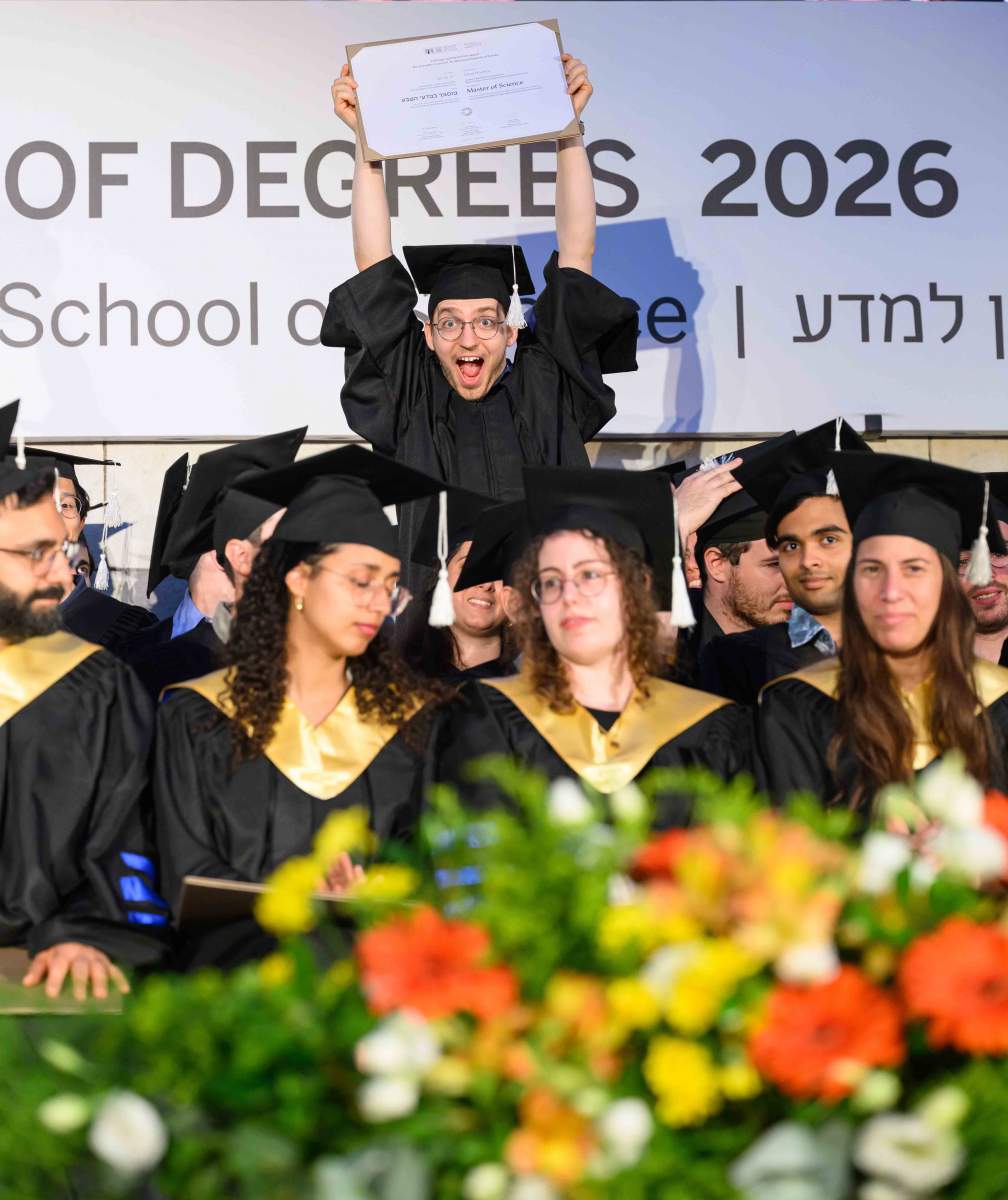
The class of 2026 is the third graduating class since the Hamas attack of October 7, 2023, and the first since missiles struck the Weizmann Institute during Iran’s attack on Israel in June 2025. These dramatic events left their mark on everyone in attendance and featured prominently in the ceremony’s speeches.
“On a day like this, it is impossible not to remember that exactly one year ago, two missiles struck the Weizmann Institute. Two missiles that turned the world upside down for all of us,” said the first speaker, Dean of the Weizmann School of Science, Prof. Maya Schuldiner. “I felt it very personally because one of them directly hit the lab of my husband, Oren [Prof. Oren Schuldiner]. I remember the moment we received the news – the painful realization that 20 years of research, work, thought, dreams and discoveries had turned to dust in an instant. It was heartbreaking.
“When we were allowed back on campus and into our lab, we found – as many labs did – that the windows and doors had been blown out and everything was covered in dust and shattered glass. Our safe space for doing science had been disrupted. So we did something very simple. We turned on some music. We rolled up our sleeves and spent an entire day cleaning and organizing until, little by little, the lab became ours again – and we became ourselves again.
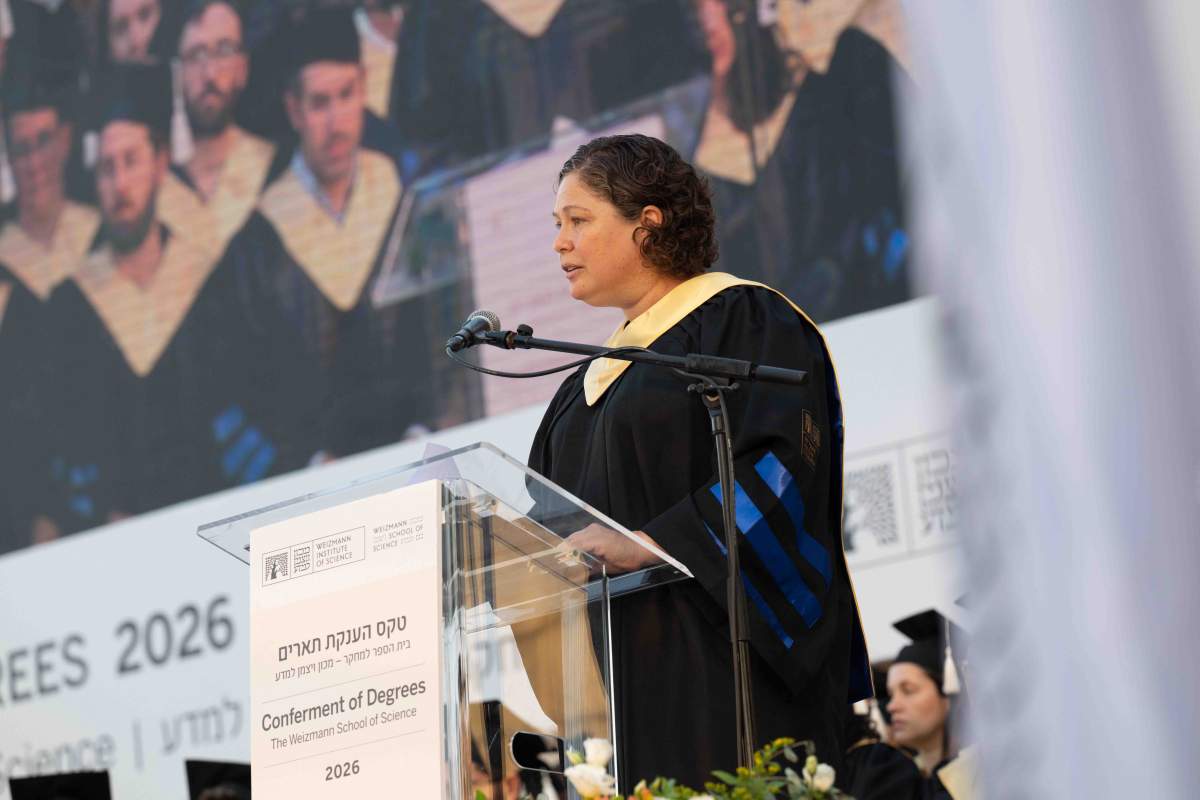
“What brought us back was not the cleanliness or the order. It was the feeling that we were facing hardship together, that we were surrounded by people we could rely on…
""Every graduate here today lost something on that day a year ago. Many of you lost your labs and your research"
“Every graduate here today lost something on that day a year ago. Many of you lost your labs and your research. For all of us, there was a period of grief when our scientific home was damaged, when our beautiful campus lay broken and devastated. Each of you had to work hard to overcome that loss and keep moving forward despite everything. But look at all of you here today – you made it…
“So today, as you set out on the next stage of your journey, I hope you will continue to be curious, courageous and excellent. But beyond that, I hope you will also be kind and compassionate. Because people who are compassionate and able to see the good do not simply succeed in the world – they make it a better place. A place where all human beings work together for the future of humanity.”
Weizmann Institute President Prof. Alon Chen also spoke about the unique challenges facing Israeli science and the broader challenges of the current era:
“You are going out into the world at a time of uncertainty, but also of unprecedented opportunity. Never before have human beings had so many tools with which to understand the world, and never before has so much responsibility been required in how those tools are used. The knowledge you have acquired, the abilities you have developed and the values you have absorbed during your studies will enable you not only to navigate a changing reality, but also to shape it.
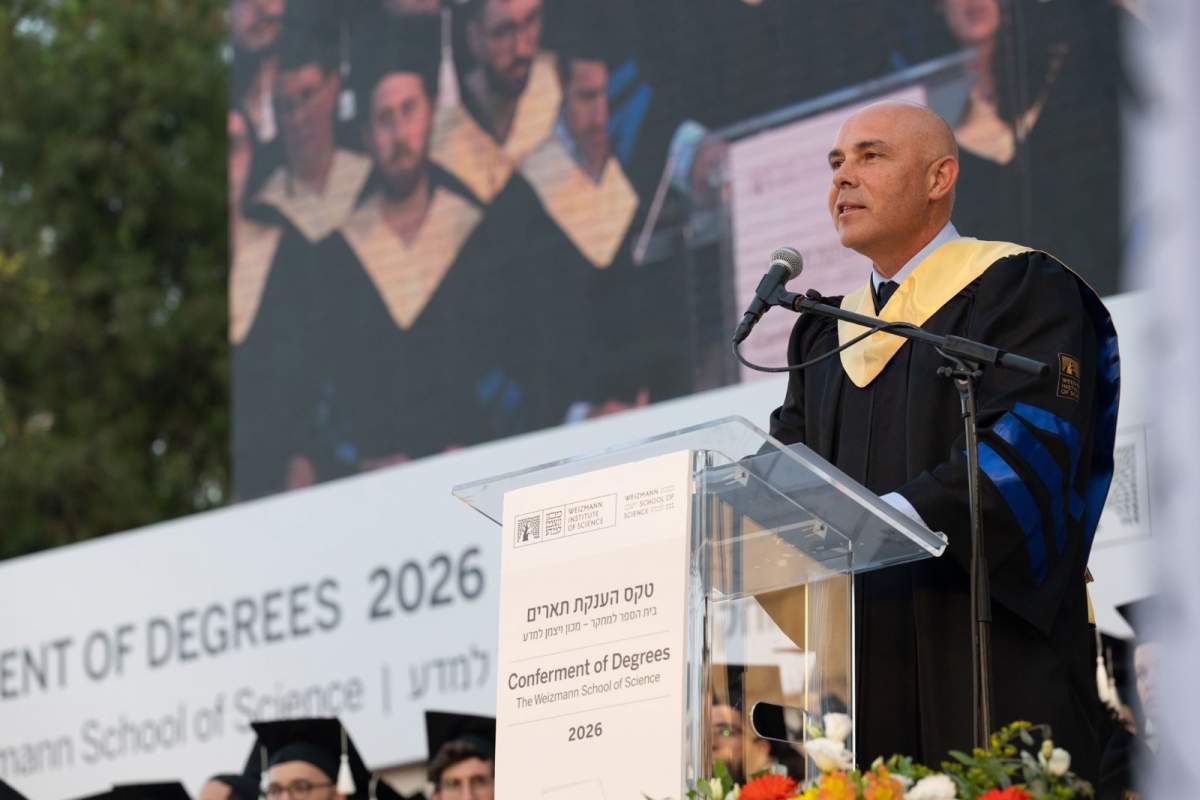
“Some of you will continue in research. Others will turn to industry, entrepreneurship or education. Whatever path you choose, remember that the future of our society will be shaped to a large extent by people like you – people who believe in the power of knowledge, in critical and creative thinking and in humanity’s ability to create positive change. The diploma you receive today marks an important achievement, but it is also an invitation to continue the journey – a journey of learning, discovery, responsibility and contribution to the society in which we live and to the future of humanity.”
Speaking on behalf of the Institute’s scientists, Prof. Nir Davidson, chair of Weizmann’s Scientific Council, also stressed the graduates’ continuing journey and their responsibilities to society and the scientific community:
“The degree you receive today is both a great privilege and a great duty. A duty to yourselves: to continue developing the talents and abilities that brought you here. In science, learning never ends. A duty to the families who loved, believed in and supported you unconditionally – repay them with love and support, and justify their trust. A duty to the scientific community you are joining: to teach and share the knowledge you have gained and will gain in the future. A duty to Israeli society, which is in need of excellent, creative and courageous scientists to lead it forward. And above all, a duty to humanity itself.
“As Dr. Chaim Weizmann, the Institute’s founder and Israel’s first president, once said: ‘I have always known that above science stand higher values, and that only in them lies a remedy for the afflictions of humanity – justice, integrity, peace and brotherhood.’ Be scientists and be human beings. Remember: The knowledge, talent and opportunities you have received are not merely a gift – they are also a loan. Pass it on.”