Dozens of research teams around the world are working to halt, treat and even prevent Alzheimer’s disease, which silently develops in the brain for more than a decade before symptoms appear. Although recent years have brought important advances, researchers continue to search for therapies that can more effectively alter the course of Alzheimer's and other forms of dementia.

Prof. Michal Schwartz of the Weizmann Institute of Science’s Brain Sciences Department has developed an innovative strategy for treating Alzheimer’s disease. A recipient of the Israel Prize in Life Sciences, Schwartz pioneered research showing that the body’s most protected organ – the brain – is tightly dependent on the immune system for its lifelong functioning, maintenance and repair. These findings overturned the long-held dogma that the brain was entirely isolated from immune activity, and that any immune activity within the brain was inherently detrimental and should therefore be suppressed.
Schwartz also revealed the critical role of age-related immune dysfunction in driving the progression of brain aging. In particular, she proposed that, regardless of a neurodegenerative disease’s primary cause, age-related decline of the immune system fuels brain inflammation, a major driver of disease progression. This finding suggested that removing amyloid plaques, long considered a hallmark of Alzheimer’s, is not sufficient to halt the disease. Her discoveries opened a new path toward developing treatments for neurodegenerative diseases by targeting the immune system.
""The goal of our biological therapy is to restore the immune system’s youthful capacity to protect the brain"
A Phase 1b clinical trial of an Alzheimer’s disease immunotherapy based on Schwartz’s work has recently been completed. The results of this first stage of clinical development – whose primary objective, as is standard for Phase 1 trials, was to evaluate safety – are reported today in Nature Medicine.
Beyond amyloid: the immune system
Instead of directly targeting Alzheimer’s amyloid plaque deposits, Schwartz’s team has focused on understanding how immune system dysfunction drives disease progression. This novel approach also reflects the growing recognition that Alzheimer’s disease is a systemic disorder, rather than solely a disease of the brain.
About a decade ago, using mouse models of Alzheimer’s disease and other forms of dementia, the team showed that transient, intermittent reduction of the suppression imposed on the immune system by inhibitory immune checkpoints, promotes the clearance of aging cells from the diseased brain, reduces brain inflammation and alleviates disease symptoms, slowing disease progression and improving memory. The researchers focused on the PD-1/PD-L1 inhibitory checkpoint pathway as a target for treatment. Building on these discoveries, Schwartz co-founded ImmunoBrain, a company dedicated to translating her research into therapies for neurodegenerative diseases.
The company licensed the underlying technology and intellectual property from Yeda, the Weizmann Institute’s tech transfer company, and developed IBC-Ab002, a humanized anti-PD-L1 antibody specifically engineered to harness the newly discovered immune mechanism for the treatment of Alzheimer's disease. Although IBC-Ab002 targets the same immune checkpoint molecule as anti-PD-L1 antibodies used in cancer immunotherapy, it has distinctive properties tailored for Alzheimer's disease.
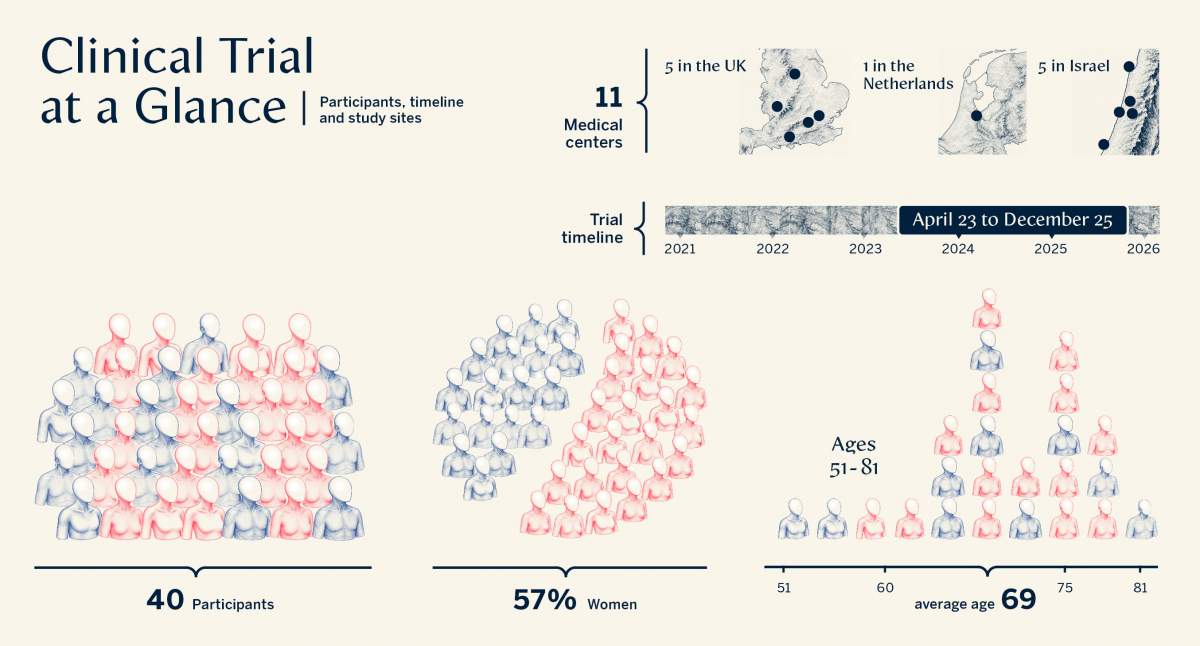
Following a series of successful studies in laboratory animals, a multicenter, international Phase 1 clinical trial enrolled 40 patients with early-stage Alzheimer's disease at 11 medical centers: five in the United Kingdom, five in Israel and one in the Netherlands. The research was headed by Schwartz, while the clinical trial was led by Dr. Tommaso Croese, formerly a PhD student in Schwartz’s lab and now vice president of clinical development at ImmunoBrain, together with Prof. Catherine J. Mummery of the Dementia Research Centre at University College London.
The trial’s results showed that the treatment was safe and well tolerated at all tested doses, and that its biological activity matched its engineered design. The treatment, aimed at reversing immune aging, also reduced biomarkers of neuronal damage, as well as biomarkers associated with loss of synaptic function. These findings support further clinical development of this innovative therapeutic strategy.